
Prime Minister of India – UPPSC Notes Polity
Introduction – Prime Minister of India (UPSC Notes Polity)
The Prime Minister of India (UPPSC Notes Polity) is the head of the government and the most powerful political authority in India. According to Article 75(1) of the Indian Constitution, the President appoints the Prime Minister. However, in reality, the President appoints the leader of the majority party or coalition in the Lok Sabha.
The Prime Minister (PM) acts as the link between the President and the Council of Ministers and plays a vital role in shaping national policies, implementing laws, and representing India at international forums.
Constitutional Provisions Related to Prime Minister (Articles 74–78)
- Article 74 – Council of Ministers to aid and advise the President
- Article 75 – Appointment, tenure, salary of the Prime Minister and other ministers
- Article 76 – Attorney General of India
- Article 77 – Conduct of business of the Government of India
- Article 78 – Duties of the Prime Minister
Appointment and Tenure of the Prime Minister
- The President of India appoints the Prime Minister.
- Generally, the leader of the majority party in the Lok Sabha is appointed.
- If no party has a clear majority, the President appoints the person most likely to command majority support in the House.
- The PM holds office as long as he enjoys the confidence of the Lok Sabha.
Powers and Functions of the Prime Minister
1. Executive Powers of PM
- Heads the Council of Ministers and allocates portfolios.
- Advises the President about ministerial appointments and dismissals.
- Supervises the functioning of various ministries.
2. Legislative Powers
- Advises the President to summon and prorogue Parliament.
- Introduces Government Bills in the Lok Sabha.
- Can recommend dissolution of Lok Sabha before its term.
- Plays a dominant role in shaping legislative policies.
3. Financial Powers
- The PM oversees the preparation and presentation of the Union Budget.
- Heads the Planning Commission (before 2015) and now influences policy through NITI Aayog.
4. Foreign Policy Role
- Represents India in international organizations such as the UN and BRICS (Brazil, Russia, India, China, South Africa).
- Conducts high-level diplomatic meetings and summits.
5. Emergency Powers
- The PM advises the President to declare National Emergency (Article 352), President’s Rule (Article 356), or Financial Emergency (Article 360).
Prime Minister vs. President (Comparison Table)
| Aspects | Prime Minister | President |
| Head of | Government | State |
| Appointments by | President | Elected by Electoral College |
| Powers | Real Executive Authority | Constitutional Head |
| Tenure | Depend on Lok Sabha majority | Fixed 5 years |
| Responsibility | Collective responsibility to Lok Sabha | No direct accountability |
Council of Ministers – Role under the Prime Minister
- The Council of Ministers is collectively responsible to the Lok Sabha (Article 75(3)).
- The PM presides over their meetings and coordinates their work.
- Without the Prime Minister, the Council of Ministers cannot function.
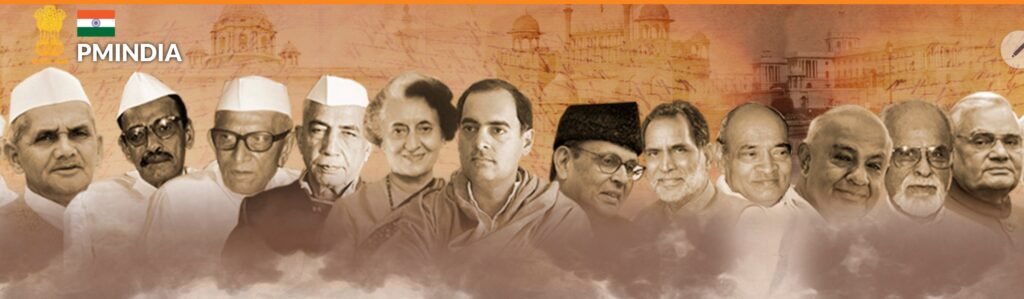
List of Prime Ministers of India (1947–Present)
| Name | Tenure | Party |
|---|---|---|
| Jawaharlal Nehru | 1947–1964 | INC |
| Lal Bahadur Shastri | 1964–1966 | INC |
| Indira Gandhi | 1966–1977, 1980-84 | INC |
| Morarji Desai | 1977-79 | Janta Party |
| Rajiv Gandhi | 1984-89 | INC |
| P.V. Narasimha Rao | 1991-1996 | INC |
| Atal Bihari Vajpayee | 1998-2004 | BJP |
| Manmohan Singh | 2004-14 | INC |
| Narendra Modi | 2014-Present | BJP |
Significance of the Prime Minister’s Office (PMO)
The PMO (Prime Minister’s Office) functions as the nerve center of the government. It assists the PM in policy formulation, coordination, and supervision of ministries.
Conclusion
The Prime Minister of India holds a pivotal position in the Indian political system. He/she ensures the smooth functioning of parliamentary democracy, maintains coordination among ministries, and represents India globally. For UPSC and State PSC aspirants, understanding the constitutional, political, and practical aspects of the PM’s role is vital.
Read More
President of India – Powers, Election &Role (UPPSC Notes )
Directive Principles of State Policy (DPSPs) – UPPSC Polity Notes