
FUNDAMENTAL DUTIES – UPPSC POLITY NOTES
Fundamental Duties of India – Complete Polity Notes for UPSC & UPPSC
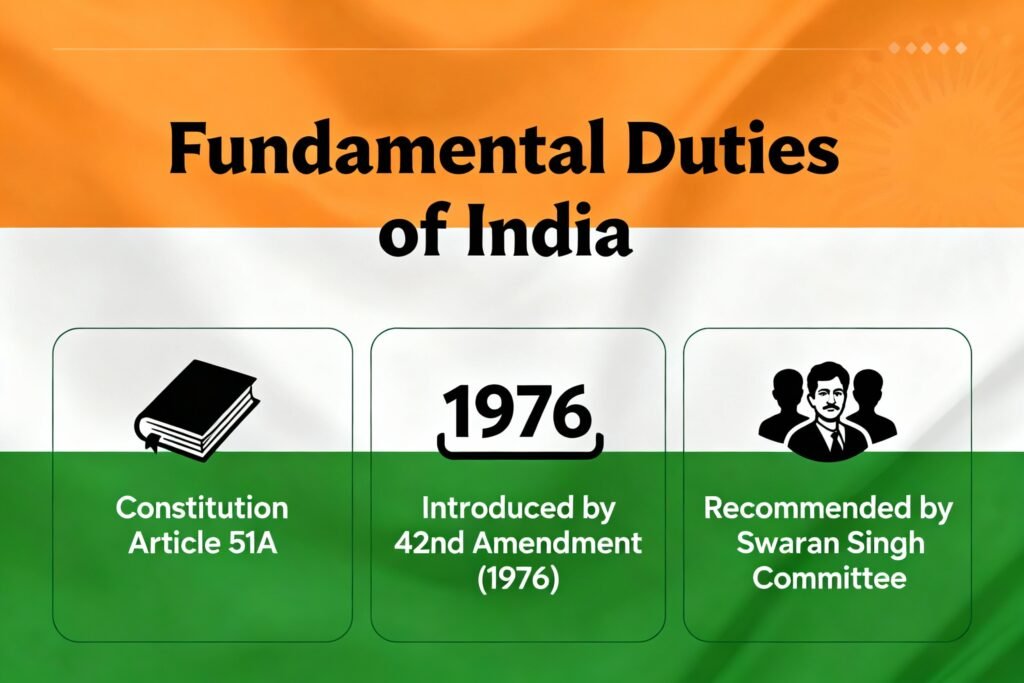
The Fundamental Duties of India constitute an important part of the Indian Constitution. Added by the 42nd Constitutional Amendment Act, 1976, these duties remind citizens of their moral obligations towards the nation. They form Part IV-A of the Constitution and are directly inspired by the Soviet Constitution. For UPSC and UPPSC examinations, this topic is highly important because it links civic responsibility, constitutional ethics, and national values.
Introduction to Fundamental Duties
The Fundamental Duties of Indian citizens serve as guidelines for responsible behavior. While Fundamental Rights (Part III) give citizens essential freedoms, Fundamental Duties (Part IV-A) create a balance by emphasizing responsibilities. These duties are non-justiciable, meaning they cannot be enforced by courts, but they hold moral and political importance.
Origin of Fundamental Duties
Swaran Singh Committee (1976)
The concept of Fundamental Duties was recommended by the Sardar Swaran Singh Committee, appointed during the Emergency period. It suggested:
- Inclusion of a separate chapter on Fundamental Duties
- Penalties for non-compliance (not accepted)
- Emphasis on national unity and discipline
42nd Constitutional Amendment Act, 1976
- Inserted Part IV-A
- Added Article 51A
- Introduced 10 Fundamental Duties
86th Constitutional Amendment Act, 2002
Added 11th Duty: To provide opportunities for education to children aged 6–14 years.
Article 51A – List of 11 Fundamental Duties
The Fundamental Duties Are:
- To abide by the Constitution and respect its ideals and institutions.
- To cherish and follow the noble ideals that inspired the national freedom struggle.
- To uphold and protect the sovereignty, unity, and integrity of India.
- To defend the country and render national service when called upon.
- To promote harmony and the spirit of brotherhood beyond religious, linguistic, regional differences.
- To renounce practices derogatory to the dignity of women.
- To preserve the rich heritage of our composite culture.
- To protect and improve the natural environment (forests, lakes, rivers, wildlife).
- To develop scientific temper, humanism, and spirit of inquiry and reform.
- To safeguard public property and abjure violence.
- To provide education opportunities to children aged 6–14 years (added in 2002).
Features of Fundamental Duties
- Moral and ethical obligations of citizens
- Non-justiciable, but courts can use them for interpretation
- Promote patriotism and discipline
- Reflect India’s composite culture
Importance of Fundamental Duties
Why Fundamental Duties Are Important?
- Promote social harmony and national integrity
- Support the implementation of Fundamental Rights
- Strengthen constitutional values
- Encourage citizenship awareness
- Help courts to interpret laws and provisions
Legal Status of Fundamental Duties
Are Fundamental Duties Enforceable?
- They are not enforceable by law, but Parliament may make laws to enforce them.
- Supreme Court uses duties to decide important cases.
Relevant Judgments
AIIMS Students Union v. AIIMS (2001) – duties are as important as rights.
MC Mehta Cases – environment-related duties used by Supreme Court.
Criticism of Fundamental Duties
Major Criticisms
- They are vague and difficult to interpret.
- No legal punishment for violation.
- Citizens are expected to follow them without awareness or education.
- Added during Emergency, so seen as a tool of political control.
Difference Between Fundamental Rights & Fundamental Duties
| Fundamental Rights | Fundamental Duties |
|---|---|
| Justicable | Non-Justicable |
| Provide Freedom | Impose responsibilities |
| Against State | For citizens |
| Parts III | Parts IV -A |
| Enforced by courts | Not enforceable |
UPSC & UPPSC Exam Importance
Fundamental Duties are regularly asked in:
UPSC Prelims
UPSC GS Paper 2
UPPSC Prelims
UPPSC Mains ( GS-I, GS-II)
Topics include amendment, committee recommendation, Article 51A, and criticism.
Previous Year Questions (PYQs)
1. UPSC Prelims 2021Q. The Fundamental Duties of citizens were added to the Constitution on the basis of the recommendations of:
(a) Shah Commission
(b) Swaran Singh Committee
(c) Sachar Committee
(d) Sarkaria Commission
Q. Which amendment added the 11th Fundamental Duty?
(a) 44th Amendment
(b) 52nd Amendment
(c) 86th Amendment
(d) 61st Amendment
3. UPPSC Prelims 2022Q. Which Article contains Fundamental Duties?
(a) 48A
(b) 51A
(c) 21A
(d) 49
Comments answer in comment box.
Conclusion
The Fundamental Duties of India form the moral foundation of citizenship. They strengthen national unity, uphold constitutional values, and guide citizens toward responsible participation in democratic life. For UPSC and UPPSC, mastering this topic ensures an understanding of constitutional philosophy and civic ethics.
Read more
Prime Minister of India – Powers, Role & Functions (UPPSC Notes Polity)