
Fundamental Duties UPSC Notes – Article 51A Explained (UPPSC Notes)
The Fundamental Duties UPSC Notes topic is one of the most important Polity chapters for both UPSC and UPPSC exams. These duties are mentioned under Article 51A in Part IVA of the Indian Constitution and list the moral obligations of every Indian citizen. They aim to promote national unity, discipline, patriotism, and constitutional values.
Historical Background of Fundamental Duties
- Initially, Fundamental Duties did NOT exist in the original Constitution of 1950.
- In 1976, during the Emergency, the Swaran Singh Committee recommended adding duties.
- Based on these recommendations, the 42nd Constitutional Amendment Act, 1976 added 10 Fundamental Duties.
- The 86th Amendment Act, 2002 added the 11th duty (regarding education for children).
Constitutional Provisions – Article 51A
Fundamental Duties are included in:
- Part IVA (added by 42nd Amendment)
- Article 51A (a–k)
- Applies to all citizens of India (unlike Fundamental Rights which apply to persons)
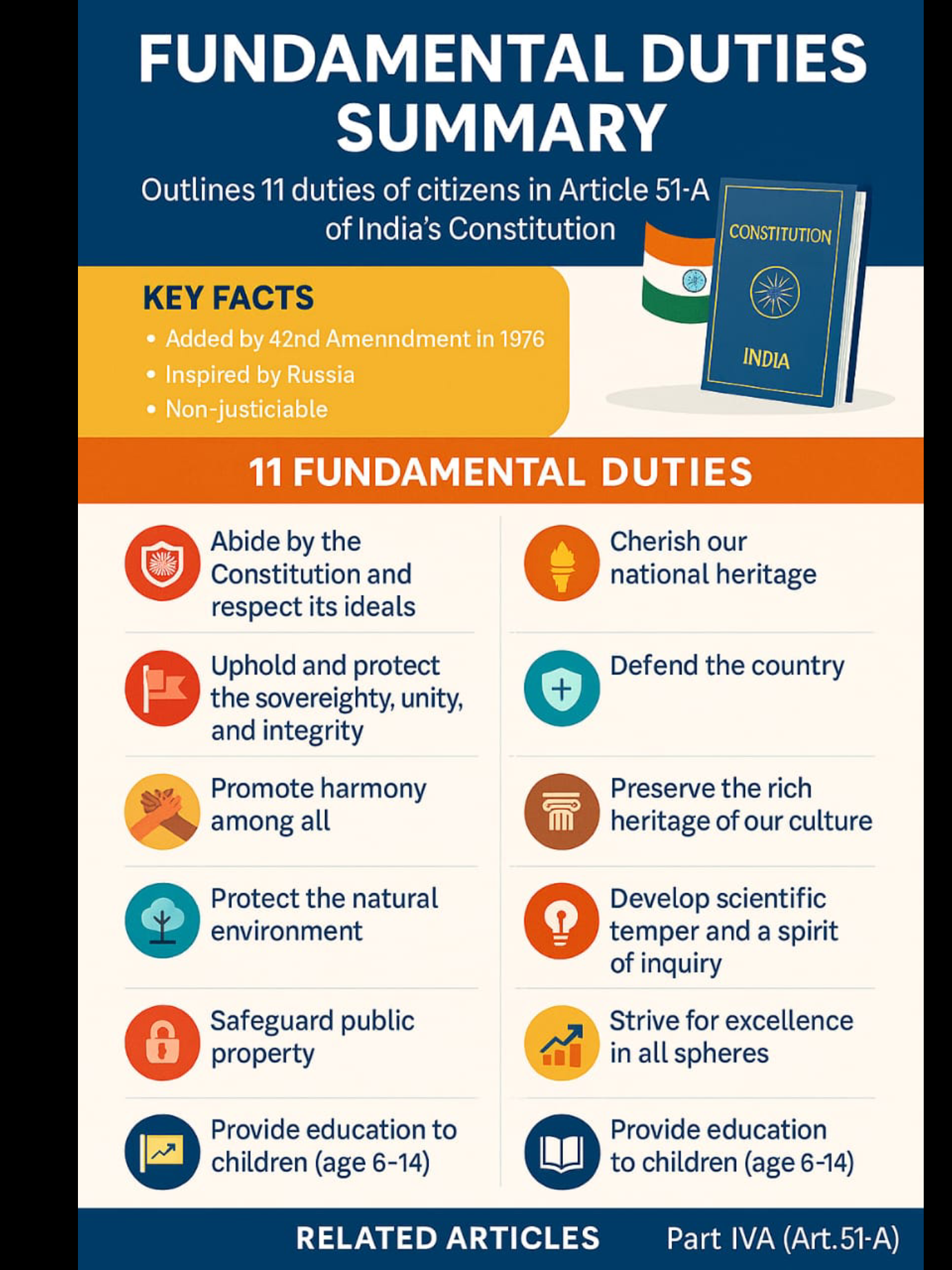
List of 11 Fundamental Duties (Article 51A)
(a) Respect the Constitution, National Flag, and National Anthem.
(b) Follow noble ideals that inspired our national freedom struggle.
(c) Uphold sovereignty, unity, and integrity of India.
(d) Defend the country and render national service when required.
(e) Promote harmony and the spirit of brotherhood beyond religious and linguistic differences.
(f) Preserve and protect the rich heritage of India’s culture.
(g) Protect natural environment—forests, lakes, rivers, wildlife.
(h) Develop scientific temper, humanism, and reformist spirit.
(i) Safeguard public property and avoid violence.
(j) Strive toward excellence in all spheres to raise national standards.
(k) (Added by 86th Amendment) Provide opportunities for education to children aged 6–14 years.
Key Features of Fundamental Duties
- They are non-justiciable (cannot be enforced by courts).
- Serve as a reminder to citizens about their moral obligations.
- Help maintain discipline, unity, patriotism, and national integrity.
- Parliament may enforce duties by enacting laws.
- Directly promote environmental protection, scientific attitude, and cultural preservation.
Fundamental Rights vs Fundamental Duties (Quick Table)
| Basic | Fundamental Rights | Fundamental Duties |
| Constitutional Part | Parts III | Part IVA |
| Number | 6 Rights | 11 Duties |
| Justiciable | Yes | No |
| Apply to | All persons | Only citizens |
| Objective | Protect liberties | Strengthen responsibility |
Important Constitutional Amendments
42nd Amendment Act, 1976
- Added Part IVA and 10 duties.
- Based on Swaran Singh Committee.
86th Amendment Act, 2002
- Added 11th duty on education (Art. 51A(k)).
- Inserted Article 21A (Right to Education).
Why Fundamental Duties are Important for UPSC & UPPSC?
- Frequently asked in both Prelims and Mains.
- Linked with Constitutional morality, governance, and civic responsibility.
- Helps understand Indian citizenship values.
Conclusion
The Fundamental Duties UPSC Notes topic is essential to understand the moral responsibilities of citizens toward the nation. Although non-enforceable, they strengthen democracy, promote unity, and help build a disciplined society. Every aspirant must memorize Article 51A and all 11 duties for the exam.
Read more
Prime Minister of India UPSC Notes
Directive Principles of State Policy UPSC Notes