
Citizenship under Articles 5–11 of the Indian Constitution
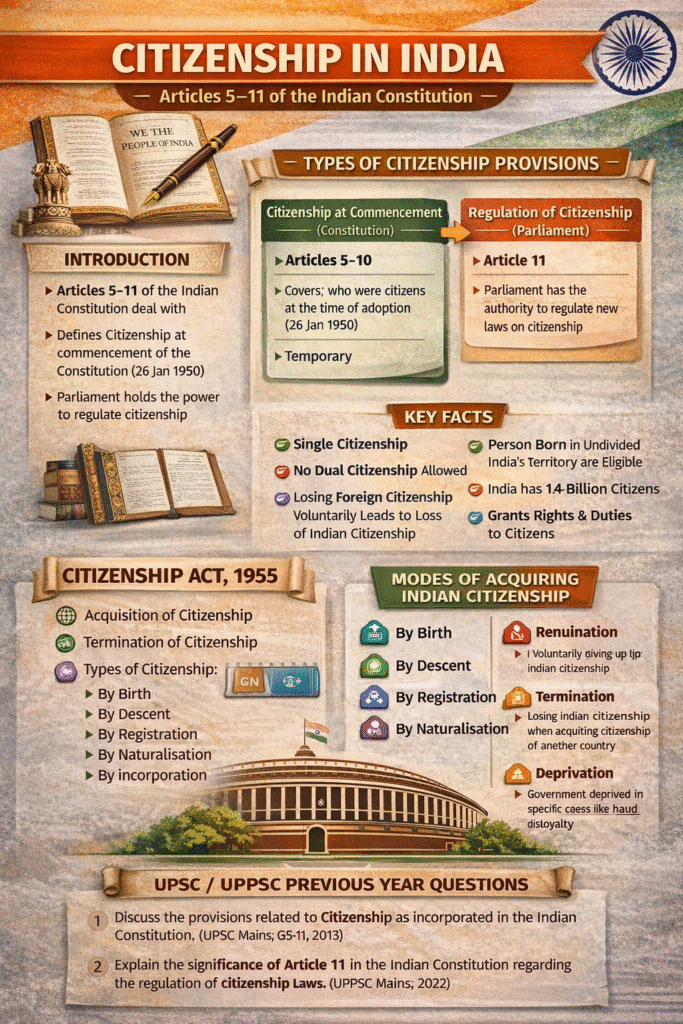
Citizenship is one of the most important concepts in political science and constitutional law. Articles 5 to 11 of the Indian Constitution deal with citizenship at the commencement of the Constitution (26 January 1950). These provisions were framed in the backdrop of Partition of India (1947) and massive population movements between India and Pakistan.
Unlike many constitutions, the Indian Constitution did not provide permanent or exhaustive citizenship rules, but only laid down initial provisions, leaving future determination to Parliament under Article 11.
This topic is highly important for UPSC, UPPSC, State PCS, and other competitive examinations, especially in Prelims (Articles, concepts) and Mains GS-II (constitutional provisions, debates, amendments, current relevance).
What is Citizenship?
Citizenship is the legal and political relationship between an individual and the State. A citizen:
- Enjoys full civil and political rights
- Owes allegiance to the State
- Is protected by the Constitution
Citizens vs Aliens
| Citizens | Aliens |
|---|---|
| Full political rights | No political rights |
| Can vote, contest elections | Cannot vote |
| Eligible for constitutional offices | Not eligible |
Background of Articles 5–11
Historical Context
- Partition of India in 1947 led to:
- Large-scale migration
- Communal violence
- Refugee crises
- Constitution-makers faced difficulty in defining citizenship permanently
- Therefore:
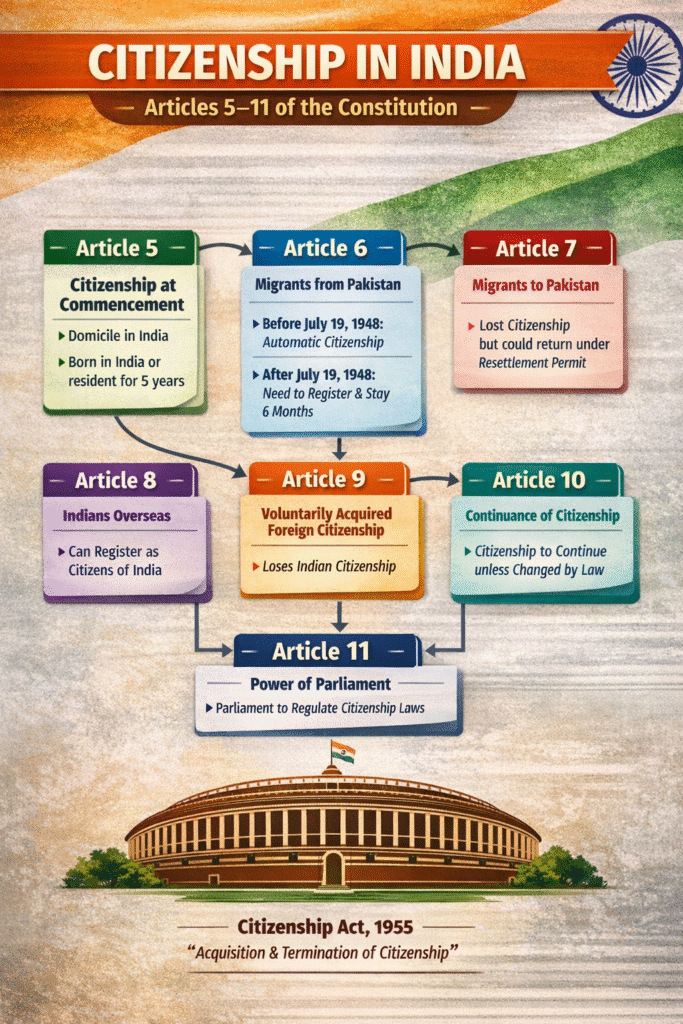
- Articles 5–10 → Citizenship at commencement
- Article 11 → Power of Parliament to regulate future citizenship
Article 5 – Citizenship at the Commencement of the Constitution
Article 5 defines who was a citizen of India on 26 January 1950.
Conditions under Article 5
A person is a citizen of India if any one of the following conditions is fulfilled:
- Domicile in India, and
- Any one of these:
- Born in India, or
- Either parent born in India, or
- Ordinarily resident in India for 5 years before 26 January 1950
Meaning of Domicile
- Permanent home
- Intention to reside permanently
- Every person has only one domicile
📌 Exam Tip:
Citizenship ≠ Domicile
Domicile is a necessary condition under Article 5.
Article 6 – Rights of Citizenship of Certain Migrants from Pakistan
Applicability
Article 6 deals with persons who migrated from Pakistan to India after Partition.
Two Categories
Category 1: Migrated before 19 July 1948
- Automatically citizens if:
- They or their parents/grandparents were born in India
Category 2: Migrated on or after 19 July 1948
- Must satisfy:
- Registration as citizen
- 6 months residence immediately before application
📌 Why 19 July 1948?
It marks the enforcement of permit system between India and Pakistan.
Article 7 – Rights of Citizenship of Certain Migrants to Pakistan
Core Provision
- A person who migrated to Pakistan after 1 March 1947:
- Ceases to be an Indian citizen
Exception
If the person:
- Returned to India under resettlement permit
- Intended to permanently settle in India
Then → eligible for citizenship under Article 6.
📌 UPSC Favorite Concept:
Article 6 and Article 7 must be read together, not in isolation.
Article 8 – Citizenship of Persons of Indian Origin Residing Outside India
Who are Covered?
- Persons of Indian origin living outside India (e.g., Burma, Sri Lanka, Africa)
Conditions
- Person or parents/grandparents born in India
- Must register with:
- Indian diplomatic mission
📌 Relevance Today:
Foundation for later concepts like:
- Overseas Citizenship of India (OCI)
Article 9 – Persons Voluntarily Acquiring Foreign Citizenship
Key Rule
- If a person voluntarily acquires foreign citizenship:
- He/she loses Indian citizenship
Important Features
- India does not allow dual citizenship
- Voluntary action is essential
📌 Supreme Court View:
Voluntary acquisition must be proven with intent.
Article 10 – Continuance of Citizenship Rights
Meaning
- Every person who is a citizen under Articles 5–8:
- Continues to be a citizen
- Subject to laws made by Parliament
📌 Static GK Box
- Article 10 ensures continuity
- Citizenship is not absolute, Parliament can regulate it
Article 11 – Power of Parliament to Regulate Citizenship
Most Important Article
Article 11 empowers Parliament to:
- Make laws regarding:
- Acquisition
- Termination
- Other matters related to citizenship
Result
- Parliament enacted:
- Citizenship Act, 1955
📌 UPSC Mains Link:
Citizenship Amendment Act (CAA) derives authority from Article 11.
Citizenship Act, 1955 (Brief Overview)
Modes of Acquiring Citizenship
- By birth
- By descent
- By registration
- By naturalisation
- By incorporation of territory
Loss of Citizenship
- Renunciation
- Termination
- Deprivation
Comparison – Indian vs American Citizenship
| Feature | India | USA |
|---|---|---|
| Dual citizenship | Not allowed | Allowed |
| Constitutional detail | Limited (Art. 5–11) | Extensive |
| Parliamentary control | High | Moderate |
Important Supreme Court Judgments
- Izhar Ahmad Khan v. Union of India
- State of Bihar v. Kumar Amar Singh
- Mohd. Raza v. State of Bombay
📌 Focus on:
- Domicile
- Voluntary foreign citizenship
- Parliamentary supremacy
Relevance for UPSC & UPPSC
Prelims
- Articles number
- Migration dates
- Domicile concept
- Article 11 powers
Mains GS-II
- Constitutional philosophy
- Citizenship vs nationality
- CAA debate (linked with Article 11)
Frequently Asked PYQ Themes
- Difference between Articles 6 & 7
- Role of Parliament in citizenship
- Domicile vs citizenship
- Loss of citizenship
Conclusion
Articles 5 to 11 form the constitutional foundation of Indian citizenship. They reflect the pragmatic wisdom of Constitution-makers, who addressed immediate post-Partition realities while allowing Parliament flexibility for future needs. Understanding these provisions is essential to grasp broader debates on rights, identity, migration, and sovereignty in India.
🔑 SEO DETAILS (for uppscnotes.in)
- Focus Keyphrase: Citizenship Articles 5 to 11
- Meta Description: Detailed UPSC & UPPSC notes on Citizenship under Articles 5–11 of the Indian Constitution with examples, tables, and exam-oriented analysis.
- Slug: citizenship-articles-5-11-indian-constitution
- Image ALT Text: Citizenship Articles 5 to 11 of Indian Constitution explained