
President of India: Election, Powers, Functions and Significance (UPSC & UPPSC Notes Polity)
Introduction
The President of India is the constitutional head of the Indian State and the first citizen of the country. Though executive powers of the Union are formally vested in the President, they are exercised in practice by the Council of Ministers headed by the Prime Minister. The office of the President symbolises the unity, authority and continuity of the Indian Republic. For aspirants of UPSC and UPPSC, the President is a core topic of Indian Polity with relevance in Prelims, Mains and Interview.
Constitutional Position of the President of India
The President is provided under Part V (Articles 52–62) of the Indian Constitution.
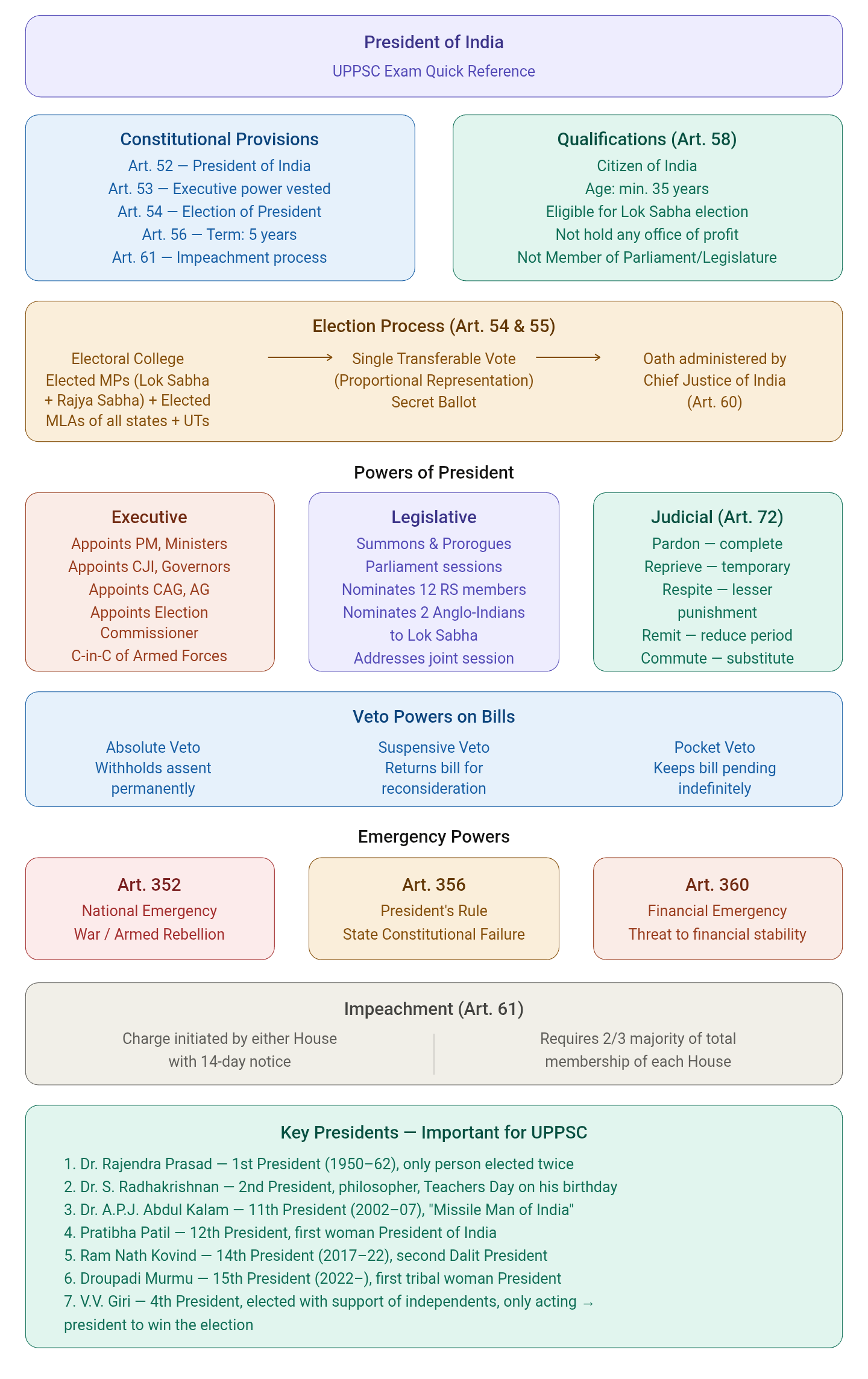
- Article 52: There shall be a President of India
- Article 53: Executive power of the Union vested in the President
- Article 74: President acts on the aid and advice of the Council of Ministers
India follows a Parliamentary system, therefore the President is a nominal executive, not a real executive.
Election of the President of India
Electoral College
The President is elected indirectly by an Electoral College consisting of:
- Elected members of Lok Sabha
- Elected members of Rajya Sabha
- Elected members of State Legislative Assemblies
- Elected members of Legislative Assemblies of Delhi and Puducherry
Nominated members do not participate in the election.
Method of Election
- Proportional Representation
- Single Transferable Vote (STV)
- Secret Ballot
This system ensures uniformity and parity between States and the Union.
Qualifications for President of India
A candidate must:
- Be a citizen of India
- Have completed 35 years of age
- Be qualified to become a member of Lok Sabha
- Not hold any office of profit
Term of Office
- Term: 5 years
- Eligible for re-election any number of times
- Holds office until successor assumes charge
Oath of Office
The President takes oath to:
- Preserve, protect and defend the Constitution
- Devote himself to the service of India
The oath is administered by the Chief Justice of India.
Powers and Functions of the President of India
Executive Powers
- Appoints the Prime Minister and Council of Ministers
- Appoints Governors, Attorney General, CAG, Election Commissioners
- Administration carried out in the name of the President
All actions are taken on ministerial advice.
Legislative Powers
- Summons, prorogues and dissolves Parliament
- Addresses Parliament (Article 87)
- Nominates 12 members to Rajya Sabha
- Assent to Bills (absolute, suspensive, pocket veto)
Financial Powers
- Money Bill introduced only with President’s recommendation
- Causes Union Budget to be laid before Parliament
- Appoints Finance Commission
Judicial Powers
- Appoints judges of Supreme Court and High Courts
- Power to grant:
- Pardon
- Reprieve
- Respite
- Remission
- Commutation
President can grant pardon even in death sentence cases.
Emergency Powers
The President can proclaim:
- National Emergency – Article 352
- State Emergency (President’s Rule) – Article 356
- Financial Emergency – Article 360
These provisions make India a unitary state during emergencies.
Impeachment of the President
- Article 61
- Grounds: Violation of the Constitution
- Can be initiated by either House of Parliament
- Requires special majority
No President of India has been impeached till date.
Is the President a Nominal or Real Executive?
Though the Constitution grants wide powers, constitutional conventions ensure that the President acts on the advice of the Council of Ministers. However, in situations like hung Parliament or constitutional crisis, the President plays a crucial discretionary role.
Thus, the President acts as a constitutional guardian, not a political authority.
Significance of the Office of President
- Symbol of national unity
- Ensures constitutional governance
- Protects democratic values
- Acts as moral authority during crises
President of India for UPSC & UPPSC
This topic is important for:
- Prelims: Articles, powers, election
- Mains: Role during emergencies, constitutional morality
- Interview: Contemporary issues and discretionary powers
Frequently Asked Questions (FAQs)
Q1. Is the President of India a real executive?
No, real executive power lies with the Council of Ministers.
Q2. Who administers the oath to the President?
The Chief Justice of India.
Q3. Can the President reject ministerial advice?
Generally no, except in rare constitutional situations.
Conclusion
The President of India represents the constitutional conscience of the nation. While the office may appear ceremonial, it plays a vital role in maintaining democratic stability and constitutional governance. A thorough understanding of the President’s powers and functions is essential for every civil services aspirant.