
Basic Structure Doctrine of the Indian Constitution (UPSC & UPPSC Polity Notes)
Basic Structure Doctrine – Meaning and Significance
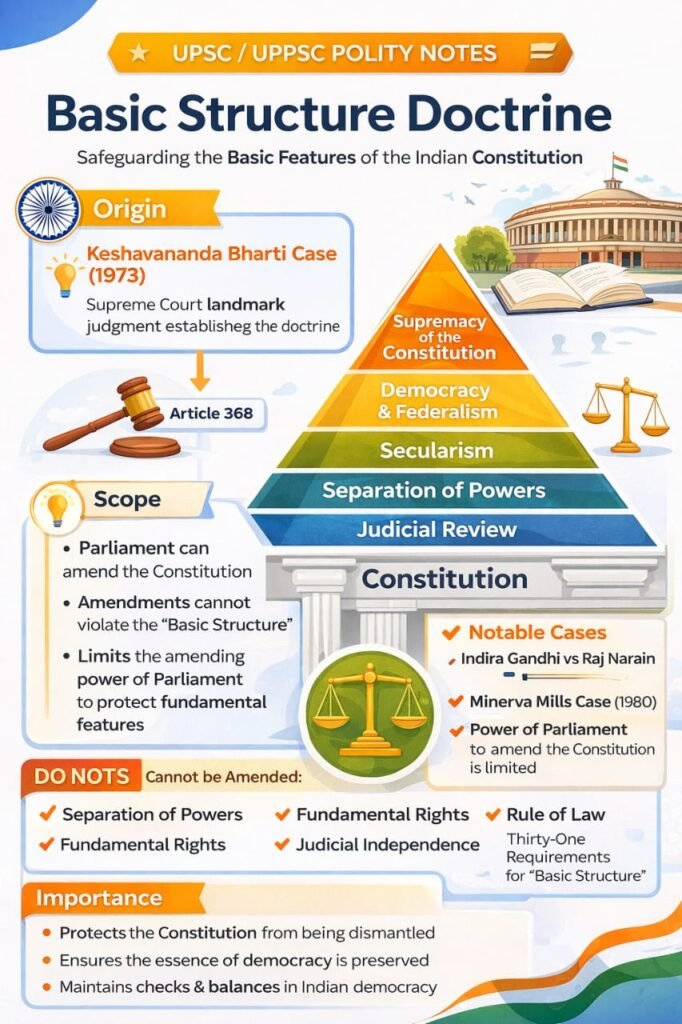
The Basic Structure Doctrine is one of the most important principles evolved by the Supreme Court of India to protect the core values of the Indian Constitution from arbitrary amendments by Parliament.
It states that Parliament has the power to amend the Constitution under Article 368, but it cannot alter or destroy the “basic structure” or essential features of the Constitution.
This doctrine ensures a balance between constitutional flexibility and rigidity, preserving democracy, rule of law, and constitutional supremacy.
Why Was the Basic Structure Doctrine Needed?
After Independence, Parliament started using its amending power frequently to:
- Override Supreme Court judgments
- Curtail Fundamental Rights
- Expand its own authority
This raised a crucial constitutional question:
Does Parliament have unlimited power to amend the Constitution?
The answer to this question led to the evolution of the Basic Structure Doctrine.
Constitutional Provision – Article 368
Article 368 – Power of Parliament to Amend
Article 368 provides:
- Procedure for constitutional amendment
- Special majority requirement
- Role of states in certain amendments
However, Article 368 does not explicitly mention any limitation on Parliament’s amending power.
The limitation was judicially created by the Supreme Court.
Evolution of the Basic Structure Doctrine (Chronological Development)
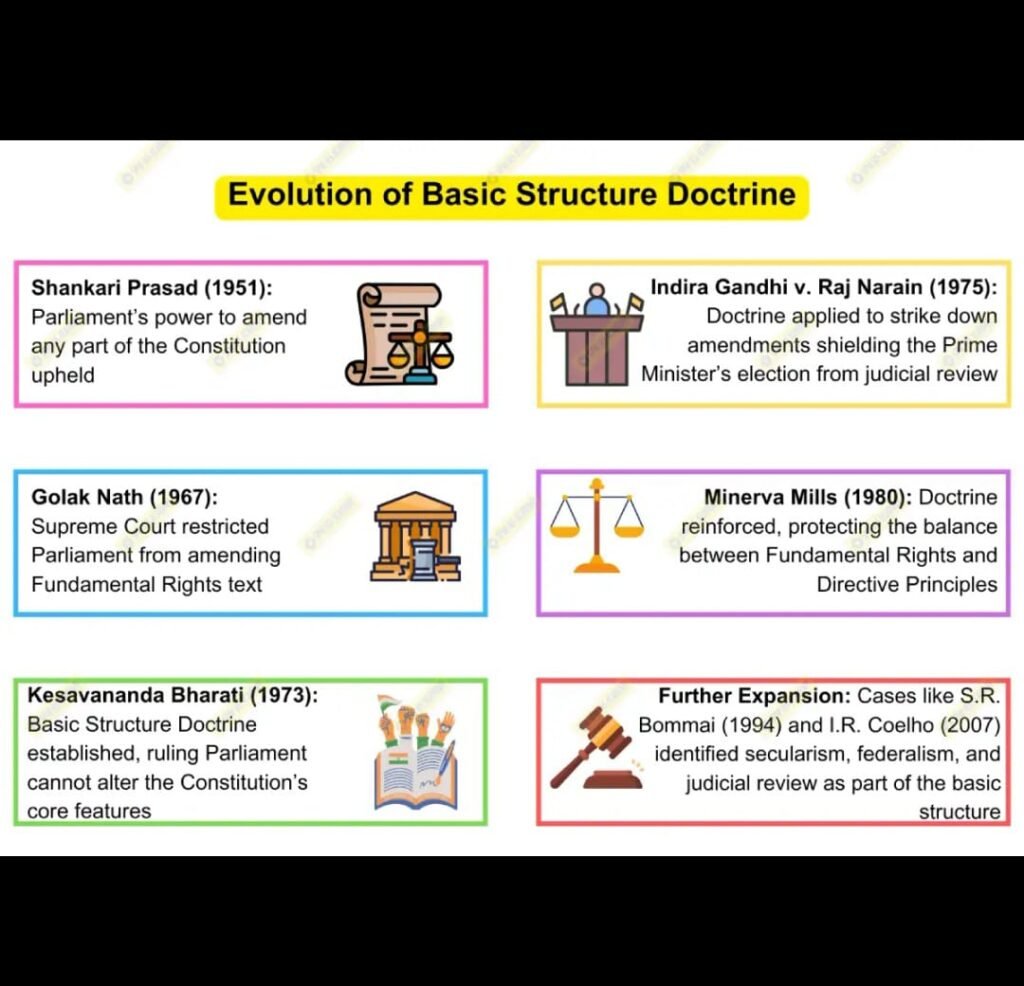
Shankari Prasad Case (1951)
Issue:
Whether Fundamental Rights can be amended under Article 368.
Judgment:
- Parliament can amend any part of the Constitution, including Fundamental Rights.
- Constitutional amendment is not “law” under Article 13.
Impact:
Parliament was given absolute amending power.
Sajjan Singh Case (1965)
Judgment:
- Reaffirmed Shankari Prasad case.
- Parliament has wide amending powers.
Important Observation:
Justice Mudholkar raised the idea that certain “basic features” of the Constitution should be beyond amendment (first hint of Basic Structure).
Golaknath Case (1967)
Turning Point Case
Judgment:
- Parliament cannot amend Fundamental Rights.
- Constitutional amendment is “law” under Article 13.
Effect:
- Parliament’s amending power was restricted.
- Led to strong political backlash.
Parliament’s Response – 24th Constitutional Amendment Act (1971)
- Restored Parliament’s power to amend Fundamental Rights.
- Explicitly stated that Article 368 gives Parliament constituent power.
This amendment directly challenged the Supreme Court.
Kesavananda Bharati Case (1973) – Birth of the Doctrine
Background
- Largest Constitutional Bench: 13 judges
- Issue: Scope of Parliament’s amending power under Article 368.
Judgment (7:6 majority)
The Supreme Court held:
Parliament can amend any part of the Constitution, including Fundamental Rights, but it cannot destroy or alter the Basic Structure of the Constitution.
Significance
- Introduced the Basic Structure Doctrine.
- Balanced Parliamentary sovereignty and Judicial review.
- Became the cornerstone of Indian constitutional law.
Elements of the Basic Structure (Not Exhaustive)
The Court did not give a fixed list. Over time, through judgments, the following have been identified:
Core Features of Basic Structure
- Supremacy of the Constitution
- Rule of Law
- Separation of Powers
- Judicial Review
- Federalism
- Secularism
- Sovereign, Socialist, Democratic, Republic nature
- Free and fair elections
- Unity and integrity of India
- Independence of Judiciary
- Limited power of Parliament to amend
⚠️ Important:
The list is open-ended, allowing judicial flexibility.
Post-Kesavananda Developments
Indira Gandhi v. Raj Narain Case (1975)
Issue:
39th Constitutional Amendment placed election disputes beyond judicial review.
Judgment:
- Judicial review is part of Basic Structure.
- Democracy and free elections are basic features.
Minerva Mills Case (1980)
Judgment:
- Limited amending power is itself a Basic Structure.
- Balance between Fundamental Rights and Directive Principles is part of Basic Structure.
This judgment strengthened the doctrine.
Waman Rao Case (1981)
- Laws placed in Ninth Schedule after 24 April 1973 can be judicially reviewed.
I.R. Coelho Case (2007)
- Any law violating Fundamental Rights and damaging Basic Structure can be struck down, even if placed in the Ninth Schedule.
Emergency in India – UPPSC Notes Polity
Relationship Between Article 368 and Basic Structure Doctrine
| Aspect | Parliament | Supreme Court |
|---|---|---|
| Amendment power | Can amend Constitution | Can review amendments |
| Limitation | Cannot damage Basic Structure | Protects Basic Structure |
| Authority | Constituent power | Guardian of Constitution |
This ensures constitutional supremacy, not parliamentary absolutism.
Importance of the Basic Structure Doctrine
Constitutional Safeguard
- Prevents authoritarianism.
- Protects democratic values.
Judicial Independence
- Ensures courts can strike down unconstitutional amendments.
Stability with Flexibility
- Allows amendments but prevents constitutional destruction.
Criticism of the Basic Structure Doctrine
No Explicit Constitutional Basis
- Not mentioned in the Constitution.
Judicial Overreach
- Critics argue courts act as “super-Parliament”.
Vagueness
- No fixed definition of “basic structure”.
Despite criticism, the doctrine is widely accepted as essential for democracy.
Relevance for UPSC & UPPSC Exams
Prelims
- Kesavananda Bharati case year
- Article related: Article 368
- Which features are part of Basic Structure
Mains
- Balance between Parliament and Judiciary
- Judicial review vs Parliamentary sovereignty
- Contemporary relevance (constitutional amendments)
Static GK Box (Quick Revision)
| Aspect | Details |
|---|---|
| Doctrine introduced in | 1973 |
| Landmark case | Kesavananda Bharati |
| Related Article | Article 368 |
| Nature | Judicial doctrine |
| Scope | Limits Parliament’s amending power |
Conclusion
The Basic Structure Doctrine acts as a constitutional shield, ensuring that while the Constitution evolves with time, its foundational philosophy remains intact.
It preserves democracy, safeguards individual liberties, and upholds the supremacy of the Constitution.
For UPSC and UPPSC aspirants, this doctrine is a must-master topic, both conceptually and analytically.
Just say the number 👍