
Emergency in India – Complete UPSC & UPPSC Notes Polity (Article 352 – 360)
Emergency in India (UPSC Polity Notes) is one of the most important topics of the Indian Constitution. It deals with situations in which the Central Government gets extraordinary powers to safeguard the sovereignty, unity, security, and governance of the country. Emergency provisions are given under Part XVIII (Article 352 – 360) of the Constitution.
Added on the basis of Weimar Constitution (Germany), these provisions enable the Union to respond effectively to war, external aggression, internal disturbance, or financial instability.
Constitutional Basis of Emergency (Part XVIII – Article 352–360)
Article Provision
Article 352 : National Emergency
Article 353 : Effect of National Emergency:*★
Article 354 : Application of Provisions relating to distribution of revenues
Article 355 : Duty of the Union to protect states
Article 356 : President’s Rule (State Emergency)
Article 357 : Exercise of Legislative Powers during President’s Rule
Article 358 : Suspension of Fundamental Rights under Article 19
Article 359 : Suspension of Remedies for Enforcement of Fundamental Rights
Article 360 Financial Emergency
Types of Emergencies under the Indian Constitution
1. National Emergency (Article 352)
National Emergency may be imposed on the grounds of:
| Grounds | Earlier Provision | 44th Amendment 1978 |
| War | Allowed | Allowed |
| External Aggression | Allowed | Allowed |
| Internal Disturbance | Allowed | Removed |
| Armed Rebellion | Not earlier | Added in 44th Amendment |
🔸 Approval Needed: Within 1 month by both Houses of Parliament
🔸 Duration: Continues for 6 months at a time, no maximum limit
🔸 Special Majority Required:
- 50% of total strength + 2/3rd of members present and voting
- Effects of National Emergency:
- Centre becomes more powerful
- Parliament can legislate on State List
- Duration of Lok Sabha & State Assemblies may be extended by 1 year at a time
- Fundamental Rights suspended (except Article 20 & 21)
2. State Emergency / President’s Rule (Article 356)
Also called Constitutional Emergency.
Grounds:
- Failure of Constitutional Machinery in a State
- Breakdown of law & order
- No clear majority after election
- State refuses to obey Union directives (Article 365)
🔸 Approval Needed: Within 2 months (Lok Sabha + Rajya Sabha)
🔸 Duration: 6 months at a time, maximum 3 years
🔸 After 1 year, extension allowed only if:
- National Emergency is in operation, OR
- Election Commission certifies that elections cannot be conducted
Effects of President’s Rule
- President assumes the executive authority of the state
- Governor acts on behalf of the Union Government
- State Council of Ministers dismissed
- Parliament frames the State budget and legislation
Critics say — Article 356 is the most misused provision of the Constitution.
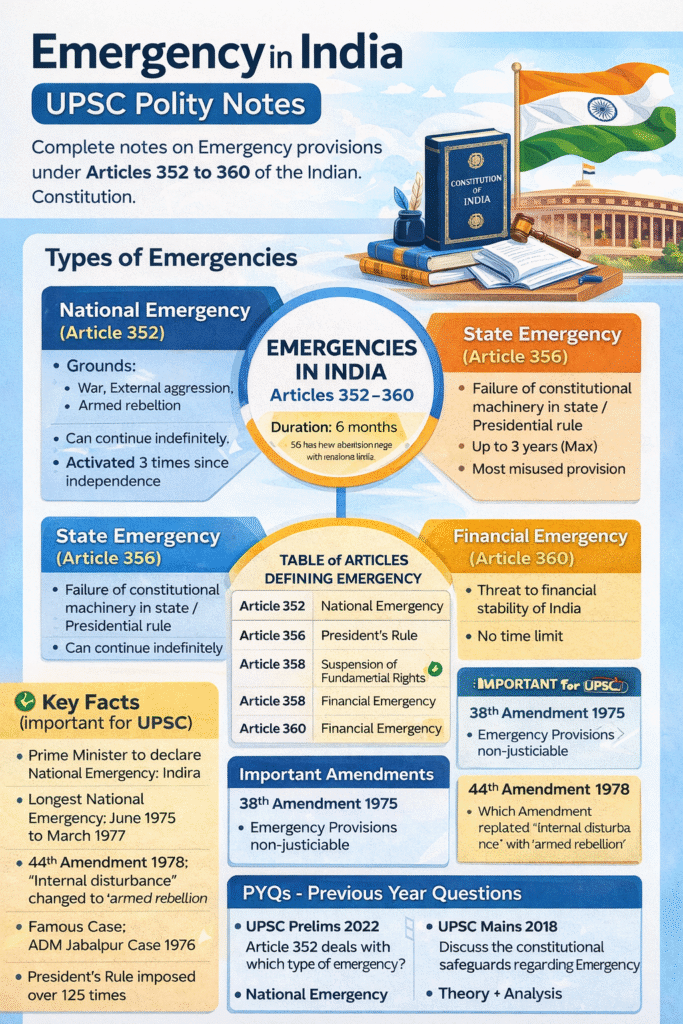
3. Financial Emergency (Article 360)
Grounds:
- Threat to the financial stability and credit of India
- Approval Needed: Within 2 months
- Duration: Indefinite, can be continued as long as required
Effects of Financial Emergency
- Union may direct States to follow financial norms
- Salaries of government employees and judges can be reduced
- All Money Bills require approval of the President
- Union gains control over expenditure and revenue
🟢 Note: No Financial Emergency has ever been declared in India so far.
Important Amendments Related to Emergency
38th Amendment Act 1975 : Emergency became non-justiciable
42nd Amendment Act 1976 : Centralization of power during Emergency
44th Amendment Act 1978 : Humanitarian reforms — safeguards for Emergency declaration
Minerva Mills Case 1980 : Judiciary restored balance between Fundamental Rights & Emergency powers
Emergency and Fundamental Rights – UPSC Important Topic
| Right | During National Emergency | During State Emergency | During Financial Emergency |
| Article 19 | Automatically suspended | Not affected | Not affected |
| Article 20 | Not suspended | Not affected | Not affected |
| Article 21 | Not suspended | Not affected | Not affected |
| Right to Constitutional Remedies | Can be suspended | Not affected | Not affected |
Supreme Court landmark case:
ADM Jabalpur vs Shivkant Shukla (1976) → Courts allowed detention without trial
Later corrected by the 44th Amendment 1978.
Static GK Box (Very Important for Prelims)
Number of Emergencies declared in India – 3 National Emergencies (1962, 1971, 1975)
Longest Emergency – 25 June 1975 – 21 March 1977 (21 months)
Emergency removed from “Internal Disturbance” – 44th Amendment 1978
Only Prime Minister who declared Emergency – Indira Gandhi
Famous Case – ADM Jabalpur Case 1976
Emergency – Advantages & Criticisms
✔️ Advantages
- Ensures national security
- Immediate decision-making
- Strong centralized control in crisis
- Protection of unity & stability
❌ Criticisms
- Risk of authoritarianism
- Suspension of rights
- Misuse for political gains
- Weakens federalism
PYQs – Previous Year Questions (UPSC/UPPSC)
Year Question Answer
| Year | Question | Answer |
| UPSC Prelims 2022 | Article 352 deals with which provision? | National Emergency |
| UPPSC Pre 2021 | Which Amendment replaced “Internal Disturbance” with “Armed Rebellion”? | 44th Amendment |
| UPSC Mains 2018 | Discuss the constitutional safeguards introduced by the 44th Amendment to prevent misuse of Emergency powers | Analytical |
| UPSC Prelims 2017 | Financial Emergency provision is under which Article? | Article 360 |
| UPPSC Mains 2023 | Evaluate the impact of Emergency provisions on federalism | Analytical |
Conclusion
The Emergency provisions (Articles 352–360) are designed to secure the nation during extraordinary situations, but they must be used with caution and strong constitutional safeguards. For UPSC and UPPSC preparation, this topic is extremely significant for both Prelims and Mains — especially themes like 44th Amendment, ADM Jabalpur case, and relation of Emergency with Fundamental Rights & Federalism.