
President of India – UPPSC Notes Polity
The President of India (UPPSC Polity Notes) is the head of the Indian State under Articles 52-78 of the Constitution.
The President of India is the head of the Indian State and the highest constitutional authority.He/She represents the unity, integrity, and solidarity of the nation and functions as the ceremonial head of the Republic of India.The real executive powers are exercised by the Council of Ministers headed by the Prime Minister, but all executive actions are formally taken in the President’s name.
Constitutional Articles Related to the President
- Article 52 : The President of India
- Article 53. : Executive power of the Union
- Article 54–58 : Election and qualification of President
- Article 59–62 :Term, re-election, and conditions of office
- Article 72. : Power to grant pardons
- Article 74–78 : Council of Ministers to aid and advise the President.
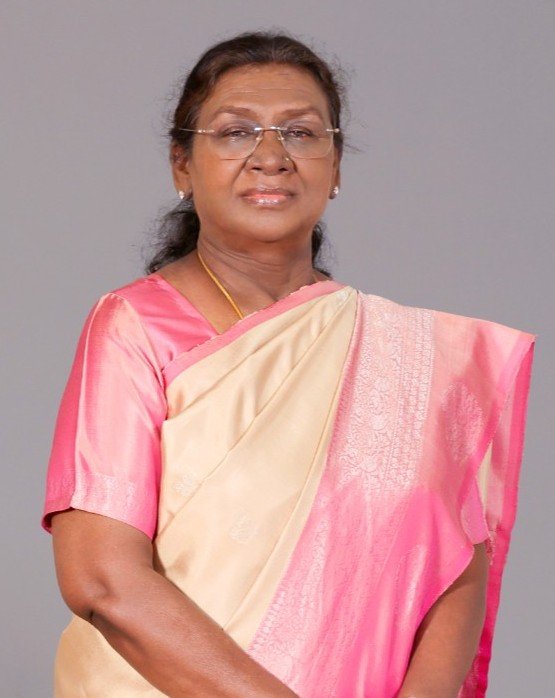
Hon’ble President of India , Smt. Droupadi Murmu
Smt. Droupadi Murmu was sworn in as the 15th President of India on 25 July, 2022. Previously, she was the Governor of Jharkhand from 2015 to 2021.
She has devoted her life to empowering the downtrodden as well as the marginalised sections of society and deepening the democratic values.
Election of the President ( UPPSC Notes Polity)
Electoral College (Article 54)
The President is elected indirectly by an Electoral College consisting of
- Elected members of both Houses of Parliament,
- Elected members of the Legislative Assemblies of all States and Union Territories of Delhi and Puducherry.
- Nominated members and Legislative Council members do not participate.
Method of Election
- Election is conducted by the Election Commission of India using the Single Transferable Vote (STV) system of Proportional Representation.
- Voting is by secret ballot.
- Each MLA’s vote value depends on the population of the state (as per 1971 census), while each MP’s vote value is uniform.
Qualifications (Article 58)
To be eligible for election as President, a person must:
- Be a citizen of India
- Have completed 35 years of age
- Be qualified for election as a member of the Lok Sabha
- Not hold any office of profit under the Government
Oath and Term (Article 60, 56)
- Oath administered by Chief Justice of India.
- Term: 5 years (eligible for re-election).
- Can resign by writing to Vice-President.
Powers and Functions of the President ( UPPSC Notes)
1. Executive Powers
All executive actions are taken in the name of the President.
Appoints:
- Prime Minister and other ministers,
- Governors of States,
- Judges of Supreme Court & High Courts,
- Attorney General, CAG, Election Commissioners, Ambassadors, etc.
- The President is the formal head of the Union Executive (Article 53).
2. Legislative Powers
- Summons, prorogues, and dissolves Parliament.
- Gives assent to bills or may return them for reconsideration (except Money Bills).
- Addresses both Houses at the commencement of the first session each year.
- Nominates 12 members to Rajya Sabha and 2 Anglo-Indian members to Lok Sabha (before 104th Amendment, 2020).
3. Financial Powers
- No Money Bill can be introduced in Parliament without his recommendation.
- Causes the Annual Budget to be laid before Parliament.
- Appoints the Finance Commission every 5 years (Article 280).
Judicial Powers
- Has power to grant pardons, reprieves, respites, or remissions of punishment under Article 72.
- Applicable to:Court-martial cases,Offences against Union law & Death sentence cases.
5. Diplomatic Powers
- Represents India in international affairs.
- Appoints ambassadors and receives foreign diplomats.
- All international treaties and agreements are signed in his name (subject to Parliament’s approval).
6. Military Powers
- Supreme Commander of the Armed Forces of India.
- Appoints Chiefs of Army, Navy, and Air Force.
- Can declare war or peace, subject to Parliament’s approval.
7. Emergency Powers
The President can proclaim three types of emergencies:
- National Emergency : Article 352 proclaim during War, external aggression, or armed rebellion
- President’s Rule : Article 356 Failure of constitutional machinery in states
- Financial Emergency : Article 360 Threat to financial stability of India
During emergencies, the President becomes the real executive head, and the Centre assumes greater power.
Impeachment of the President (Article 61)
- The President can be impeached only for “violation of the Constitution.”
- Motion must be:Signed by one-fourth of the total members of either House & Supported by two-thirds majority of both Houses after investigation.
- The Vice-President presides during impeachment proceedings.
- No President has been impeached in India till date.
Position of the President in the Indian Polity
The President is a constitutional head, not the real executive.
India follows the Parliamentary form of Government, where: “The President is the nominal head, and the Prime Minister is the real head.”
However, during emergency or political instability, the President’s powers become significant and decisive.
Important Supreme Court Cases
1. Mohd. Saeed v. State of U.P. (1974): Defined “office of profit.”
2. Samsher Singh v. State of Punjab (1974): President acts on advice of Council of Ministers.
3. SR Bommai v. Union of India (1994): Limited misuse of President’s Rule.
Summary
The President of India embodies the sovereignty and unity of the nation.Though the role is largely ceremonial, the President ensures that governance functions within constitutional limits.In times of emergency or crisis, the President acts as the guardian of the Constitution, upholding the spirit of democracy.
Also Read : Fundamental Rights of the Indian Constitution – UPPSC Polity Notes
UPSC / UPPSC Previous Year Questions
Who administers the oath of office to the President of India?
A. Vice-President
B. Chief Justice of India
C. Prime Minister
D. Speaker of Lok Sabha
2. Which Article deals with the impeachment of the President?
A. Article 60
B. Article 61
C. Article 62
D. Article 63.
3. The President can proclaim a National Emergency on the grounds of –
A. War, external aggression, or armed rebellion
B. Internal disturbance only
C. Failure of constitutional machinery
D. Financial instability
Answer in the comment box
Static GK ( Quick Facts)
Articles – 52-78
Oath by – CJI
1st President – Dr. Rajendra Prasad
Term – 5 Years
Salary (2024) – ₹5,00,000 per month
Residence – Rashtrapati Bhavan, New Delhi
Power – Executive, Legislative, Judicial, Diplomatic, Military, Emergency