
Union & Its Territory – Complete UPSC & UPPSC Polity Notes (Articles 1–4)
The Part I (Articles 1 to 4) of the Indian Constitution deals with the Union & its Territory. It defines what constitutes India (Bharat), its political boundaries, formation of states, alteration of state boundaries, names of states, and acquisition of new territories. For UPSC & UPPSC, this topic is highly important because it forms the foundation of Indian federalism and territorial structure.
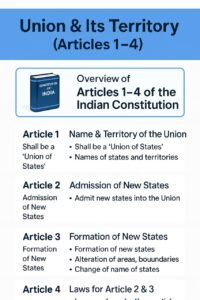
Article 1 – Name and Territory of the Union
Article 1(1) — “India, that is Bharat, shall be a Union of States.”
🔹 The name of the country is India (Bharat)
🔹 India is described as a Union of States, not a federation.
❗ Why Constitution uses “Union of States” instead of “Federation of States”
Dr. B.R. Ambedkar explained:
- The Union is indestructible
- States cannot secede from the Union
- Indian federation is created not by agreement of states, but by the Constitution itself
Article 1(2) — Territory of India includes:
- Territories of the States
- Union Territories
- Territories that may be acquired
Article 1(3) — Three Components of “India’s Territory”
State Territory : 28 States
Union Territory : 8 UTs
Acquired Territory : Any territory India acquires in future
Article 2 – Admission or Establishment of New States
Empowers Parliament to:
- Admit new states into the Union
- Establish new states on terms & conditions decided by Parliament
🔹 Example: Sikkim became a full state in 1975.
Article 3 – Formation of New States and Alteration of Areas / Boundaries / Names
Parliament can change:
Formation of new : State New states can be created
Increase area : Add territory
Diminish area : Reduce territory
Alter boundaries. : Restructure borders
Alter name. : Change name of any state
🔹 Mandatory Step
Before changing boundaries/ name/ area of a state — ➡️ President must seek the opinion of the State Legislature.
❗ But — State’s opinion is not binding.
Examples
Andhra Pradesh split into Telangana : 2014
Uttaranchal renamed Uttarakhand : 2007
Orissa renamed Odisha : 2011
Article 4 – Laws under Article 2 & 3 are Constitutional Amendments
- Any law passed under Article 2 or 3 automatically amends the Constitution
- ❗ But does not require the procedure of Article 368 ➡️ Means — Simple majority in Parliament is enough, not special majority.
Meaning of Territory vs. State Boundaries
Territory : Physical area of India
State : Administrative & political division
Nation : People + Territory + Government + Sovereignty
Why UPSC asks questions from Articles 1–4
Because these Articles reflect core concepts of:
- Federalism
- Union–State Relations
- Legislative supremacy of Parliament
- Integrity of India
Summary (Quick Revision Table)
Article 1 : Name & Territory. : India = Bharat = Union of States
Article 2 : New States : Admission / establishment of new states
Article 3 : Reorganization. : Change area, name, boundaries
Article 4 : Constitutional Amendment : Laws under Article 2 & 3 amend Constitution, simple majority
Important Facts for UPSC / UPPSC
✔ India is a Union of States (not a federation)
✔ Parliament has supreme power in territorial matters
✔ States cannot secede
✔ Acquired territories automatically become part of India
✔ President refers proposals to State Legislature, opinion not binding
Previous Year Questions (PYQs)
UPSC PYQs
1️⃣ “Why is India called a ‘Union of States’ and not a federation of states?” — 5 marks
2️⃣ Explain the powers of Parliament under Article 3 for reorganization of states. — 10 marks
UPPSC PYQs
1️⃣ Write short notes on Article 2 and Article 3 of the Constitution.
2️⃣ Discuss the constitutional provisions regarding alteration of the name and boundaries of states.
FAQs for Exam Preparation
Q1: Can a State stop Parliament from altering its boundary?
➡ No. State’s opinion is consulted but not binding.
Q2: Can Parliament change the name of a State?
➡ Yes — under Article 3.
Q3: Does Article 4 require special majority?
➡ No — Simple majority is enough.
Fundamental Rights of the Indian Constitution – UPPSC Notes Polity
Fundamental Duties UPSC Notes – Article 51A Explained (UPPSC Notes)